
Wildlife & Nature · In depth: plants
The tree of life that crossed the oceans: the coconut palm
A seed that sails, a palm that feeds whole islands and a crab that cracks its nuts. How Cocos nucifera reached every tropical shore, what it does to the atolls it colonises, and why the tree of life still needs looking after.
Most seeds travel light. The coconut does the opposite. It sets out with a fibrous life jacket, a hard hull, a tank of fresh water and enough food for months, and then it waits for the tide. Wherever it washes up, in the right conditions, a palm can follow. That is how one plant came to frame almost every tropical beach on the planet, and how it earned its oldest title.
In Sanskrit it is the kalpa vriksha, the tree that provides life’s necessities; in Malay, pokok seribu guna, the tree of a thousand uses; in the Philippines, simply the tree of life.
A seed built like a boat
Botanically, the coconut palm, Cocos nucifera, is a member of the palm family, the Arecaceae, and its name is a plain description: nucifera means nut-bearing. The tree is the most economically important palm on Earth, a slender, ringed and usually leaning trunk that can reach 25 metres, topped with a crown of giant feather-shaped leaves.

Photo Credit
Image courtesy of © Filo gèn’ · CC BY-SA 4.0The ‘nut’ is no nut at all. It is a drupe, a single-seeded fruit like a plum or a cherry, only built for the sea. Under a skin about a tenth of a millimetre thick lies the husk, one to five centimetres of fibre, and inside that the shell, three to six millimetres of hard, woody casing. The white flesh and the water within are the seed’s food store, its endosperm, solid and liquid.
At one end of the shell sit three dark eyes. Two are hard. The third is soft, and it is through this ‘germ pore’ that the shoot will push out. The fruit takes 330 to 420 days to develop after pollination, and germination is no sprint either: a nut can take 60 to 220 days to sprout. Inside, meanwhile, a spongy, pear-shaped organ, the haustorium, swells until it fills most of the cavity, drawing on the stored food for the seedling.
The husk and the air in the nut give it buoyancy, and the sea does the rest. A review of the fruit’s biology in the journal Plants reports that a wild coconut can survive about 110 days afloat, a voyage estimated at 4,800 kilometres. That is a long way for a seed with no map.

Photo Credit
Image courtesy of © Nick Longrich · CC BY-SA 4.0Yet the botanists Hugh Harries and Charles Clement argue that the great ocean crossings were never the main trick. In their reading, the wild coconut was a creature of coral atolls, dropping nuts into the lagoon every month so that viable seed was always on hand when a new island rose from the reef. The palm followed the coral, island by island, over geological time.
Two homelands and a great many sailors
Where did it all begin? In 2011 Bee Gunn, Luc Baudouin and Kenneth Olsen of Washington University in St Louis read the DNA of 1,322 coconuts from around the tropics. The palms split cleanly into two families, one of the Pacific, one of the Indian Ocean and the Atlantic, and the authors proposed two separate origins of cultivation: island Southeast Asia and the southern margins of the Indian subcontinent.
People then took over from the tide. The study found Pacific coconuts mixed into the Indian Ocean family in the southwest of that ocean, consistent with Austronesian seafarers carrying them along the ancient trade route from Southeast Asia to Madagascar. Pacific coconuts on the Pacific coast of Central America appear to have been carried there too, in pre-Columbian times.

Photo Credit
Image courtesy of © Bjørn Christian Tørrissen · CC BY-SA 4.0The Atlantic was a latecomer. Historical records show the coconut was unknown in the Caribbean and Atlantic basins until after European colonisation; the Portuguese carried Indian Ocean coconuts to West Africa, and the Spanish brought Philippine palms to Mexico’s Pacific coast. Even the name is a sailor’s joke: in sixteenth-century Portuguese, coco meant a head, and a ghost of folklore, and the three marks on the shell looked like a face.
Before that, Marco Polo had called it nux indica, the Indian nut, after the Arabic name.
The farmers left their mark on the tree as well. Polynesians knew two kinds: niu kafa, oblong and triangular with a large share of fibrous husk, and niu vai, round and often brightly coloured, with plenty of water when young. The traits of a truly domesticated palm, the dwarf habit, self-pollination and the round niu vai fruit, appear only in the Pacific group.
Fossils hint at a much longer story. Cocos-like fruits about the size of a strawberry have been found in New Zealand rocks from the Miocene, between 23 and 5.3 million years old, though their family ties are still debated.
Life on the palm
Where the coconut goes, a giant follows. The coconut crab, Birgus latro, is a land-living hermit crab and, says London’s Natural History Museum, the biggest land-dwelling arthropod on Earth, with a leg span of up to a metre. It cracks into green coconuts for the white flesh, lives for up to 60 years and ranges from islands off Zanzibar to the Gambier Islands of the eastern Pacific.

Photo Credit
Image courtesy of © Neisyaranifauzia · CC BY-SA 4.0It is less of a vegetarian than its name suggests. The museum records coconut crabs taking boobies nesting on their islands, attacking in the dark. The giants are in trouble themselves. The crab is now listed as Vulnerable on the IUCN Red List, after a 2022 assessment, its first since 1996; it is threatened by coastal development and by harvesting for the table.
When the palm takes over
Here the tree of life shows a less generous side. On a coral atoll, a coconut grove can crowd out the native forest, and a study published in 2024 in Environmental Research Letters, led by Michael Burnett of the University of California, Santa Barbara, with The Nature Conservancy, used satellite images to measure how far.
Coconut palms now cover 58.3 per cent of the forested area of the atolls mapped, and more than half of those canopies are pure monocultures.
Why does it matter? Many seabirds will not nest in coconut palms; the red-footed booby and the great frigatebird prefer broad-leaved native trees. The researchers link the switch from native forest to coconut with groundwater depletion, falling seabird numbers and harm to the neighbouring reefs. The birds matter to the sea: their guano feeds the plankton that feed the fish and the corals.

Photo Credit
Image courtesy of © USGS Unmanned Aircraft Systems · CC BY 2.0The clearest experiment is at Palmyra Atoll, some 1,000 miles south of Hawaiʻi. When rats were removed in 2011, nothing was left to eat the fallen nuts, and coconuts sprang up everywhere. By 2016 an estimated 29,000 adult palms and two million seedlings covered its islands.

Photo Credit
Image courtesy of © USGS Unmanned Aircraft Systems · CC BY 2.0In April 2019 the U.S. Fish and Wildlife Service, Island Conservation and The Nature Conservancy began the Palmyra Atoll Rainforest and Reef Resilience Project to tip the balance back. In October 2021 its team passed one million palms controlled, about half of the target, while volunteers planted native trees.
Pisonia grandis, a native tree favoured by nesting seabirds, answered in late 2020 with a masting event, a mass season of flowers and seed.
It is the sort of gardening that would bewilder a Sri Lankan villager. The lesson is not that the coconut is a villain, but that a tree so generous to people can be a bully to an island when nobody is eating its seeds.
A thousand uses, and counting
Everywhere else, people have spent a very long time finding uses for every part of it. Indonesians say the coconut has as many uses as there are days in the year. The flesh is eaten fresh or dried; dried, it is copra, from which coconut oil, one of the world’s major vegetable oils, is pressed. The Philippines, India and Indonesia lead in copra, and across the South Pacific it is among the most important exports.
The husk gives coir, a fibre so resistant to salt water that it is spun into ropes, woven into mats and baskets, bound into brushes and brooms and used by gardeners. The young flower stalks, cut, bleed a sweet sap that becomes sugar, or ferments into toddy and is distilled into spirits. The leaves thatch roofs and become baskets and hats, and the dense, speckled trunk is sold as a cabinet wood called porcupine wood.

Photo Credit
Image courtesy of © Roseli1990 · CC0Getting at any of it often means going up, as the climber above shows. In Sri Lanka the toddy tappers walk ropes strung between the crowns so they climb once and work a whole row, as the Sri Lanka Tourism film below shows.
Keeping the tree of life alive
For all its fame, the coconut is a smallholder’s crop: most of the world’s coconuts come from small plantations. A palm starts bearing after five or six years, reaches full bearing at about fifteen and goes on paying its way until it is about fifty. A good tree gives some 50 nuts a year, a great one perhaps 100, each taking a year to ripen. Patience is part of the crop.
The palm has its enemies. Lethal yellowing, a disease caused by a phytoplasma, has struck plantations in Africa, India, Mexico, the Caribbean and the Pacific. Some coconut types hold out against it better than others, one more reason the old varieties of each region are worth keeping.
Coasts are the coconut’s home, and coasts are changing. On Tarawa in Kiribati, the government photographed palms standing on shores eaten by erosion and drought. The palms in the picture are still standing, just.

Photo Credit
Image courtesy of © Government of Kiribati · CC BY 3.0Some countries take the tree as seriously as it deserves. Sri Lanka grows its palms across a Coconut Triangle of Kurunegala, Puttalam and Gampaha, and has a Coconut Research Institute in the middle of it. Our Sri Lanka guide tells the island’s side of the story, from the grater to the temple lamp, in Kapruka: the coconut, Sri Lanka’s tree of life.
Our advice: to see the wild coconut’s world, visit an atoll or a quiet motu and look at the high-tide line, where sprouting nuts lie waiting for their chance. Keep away from coconut crabs, which have a grip to respect, and never buy one to eat: they are slow-growing and Vulnerable. On a plantation, look up before you sit down. A ripe nut falling from 25 metres is the one coconut fact nobody needs to test.
Films
On film
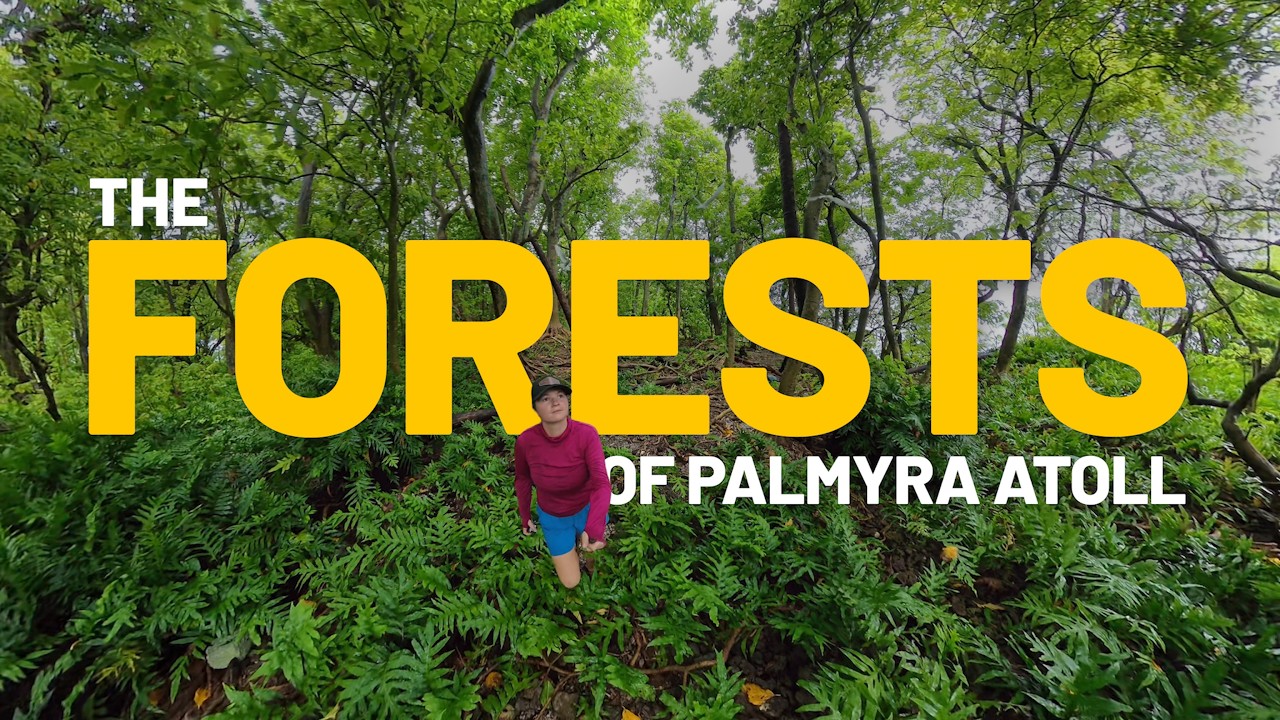 The Forests of PalmyraVideo © The Nature Conservancy in Hawaiʻi and Palmyra
 The Birds of Palmyra AtollVideo © The Nature Conservancy in Hawaiʻi and Palmyra
 Meet the Crabs of Palmyra AtollVideo © The Nature Conservancy in Hawaiʻi and Palmyra
 Toddy Tapper Life in Sri LankaVideo © Sri Lanka Tourism
Films play from YouTube, which may set its own cookies once one starts.
The coconut is a seed that packed its own water, its own food and its own boat.
Sources
- Gunn, Baudouin & Olsen (2011), Independent origins of cultivated coconut (Cocos nucifera L.) in the Old World tropics, PLoS ONE
- Washington University in St Louis: Deep history of coconuts decoded (2011)
- Harries & Clement (2014), Long-distance dispersal of the coconut palm by migration within the coral atoll ecosystem, Annals of Botany
- Fruit biology of coconut (Cocos nucifera L.), Plants (2022)
- Encyclopaedia Britannica: Coconut palm
- Wikipedia: Coconut (etymology, names, fossils, lethal yellowing)
- Natural History Museum, London: Coconut crabs, bird-eating giants on tropical islands
- Mongabay (2022): Coconut crabs are vanishing island by island
- The Nature Conservancy: Coconut palms dominate over half of Pacific atoll forests (2024)
- The Nature Conservancy: One million invasive palms removed at Palmyra Atoll (2021)


