Science & Space · In depth: the climate clock
The man who timed the ice ages: Milutin Milanković and the orbital clock
A bridge-builder from Dalj, a chair of mathematics in Belgrade and a sum that took decades. How Milutin Milanković worked out that the ice ages keep time with the Earth’s orbit, and how mud from the bottom of the ocean proved him right.
Again and again in the Earth’s recent past, sheets of ice have spread across the northern continents and then melted away, like a tide too slow for any one life to watch. Why they came, and why they seemed to keep a schedule, was one of the great puzzles of science. The answer did not come from a glacier. It came from a desk in Belgrade, where a former bridge-builder spent decades doing sums about sunlight.
The engineer from Dalj
Milutin Milanković was born in 1879 in Dalj, then in the Austro-Hungarian Empire and today in Croatia. He studied civil engineering in Vienna, graduated in 1902 and took his doctorate in 1904, the first Serb, according to the Serbian Academy’s Mathematical Institute, to earn one at Vienna’s great school of engineering.
He then did what engineers do, and did it well. From 1905 he worked in Vienna as a design engineer, a pioneer of reinforced concrete, building dams, bridges and viaducts. For his Viennese employers he even designed a sewerage system for Belgrade. The man who would one day calculate the climate of Mars began by working out where the capital’s rainwater should go.

Photo Credit
Image courtesy of © Sadko, Wikipedia · CC BY 4.0In 1909 he left engineering in Vienna for the chair of applied mathematics at the University of Belgrade, a post he held for the rest of his life. He arrived with a problem of almost reckless ambition: a mathematical theory of climate, built on nothing more than how much sunlight each latitude receives in each season, and how that changes as the planet moves.
A prisoner with a library card
War nearly ended the project before it began. In 1914 he was interned, first at Nezsider and then in Budapest, where he was allowed to work in the library of the Hungarian Academy of Sciences. He kept calculating. Few prisoners of war have made better use of a reading room.
In 1920 the results appeared in Paris as Théorie mathématique des phénomènes thermiques produits par la radiation solaire. He turned the same equations on the neighbours, too, and arrived at an average of minus 17°C for the surface of Mars. The planet would later return the favour with a crater.
Three rhythms in the sky
The theory rests on three slow movements of the Earth, which NASA describes in plain terms. The first is the shape of the orbit. It stretches from almost a circle to a slightly longer oval and back, over roughly 90,000 to 100,000 years. Even today the Earth is about 5 million kilometres closer to the Sun in early January than in early July.
The second is the tilt of the axis, which nods between 22.1 and 24.5 degrees over a cycle averaging about 40,000 years. More tilt makes harsher seasons, with warmer summers and colder winters; less tilt makes gentler ones. The tilt today is about 23.4 degrees, and slowly falling.
The third is precession: the axis wobbles like the spin axis of a top that is winding down, tracing a circle on the sky. Combined with the slow swing of the orbit itself, it shifts the seasons against the Earth’s nearest and furthest points from the Sun, on a cycle averaging about 23,000 years. At present the northern summer falls near the furthest point.

Photo Credit
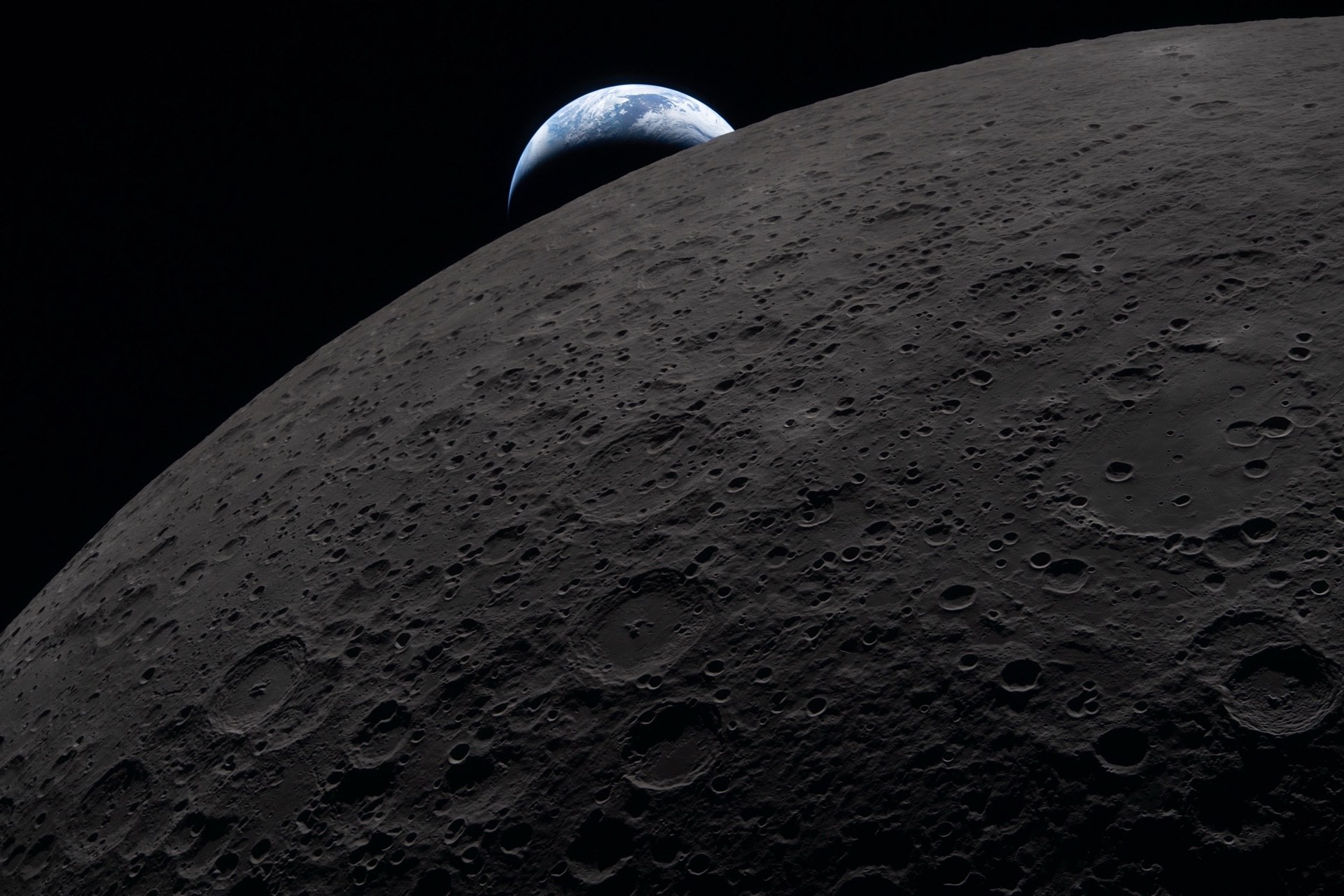
Image courtesy of © NASA / Apollo 17 crew · Public domainThe decisive idea was where to look. At the suggestion of the German climatologist Wladimir Köppen, Milanković chose summer sunshine at 65 degrees north, near where the great ice sheets grew. Cool summers there could leave winter snow unmelted, year after year, until it built into ice. And snow, which reflects sunlight back to space, cools the world a little further.
In 1924 Köppen and his son-in-law, Alfred Wegener, put Milanković’s curve into their book on the climates of the geological past.
The Canon
Using all three rhythms, he calculated the sunshine reaching each latitude, and the surface temperatures that followed, for 600,000 years before 1800, all long before electronic computers. The life’s work was gathered in 1941 as the Kanon der Erdbestrahlung und seine Anwendung auf das Eiszeitenproblem, the Canon of Insolation and the Ice-Age Problem: 626 pages in German. An English translation followed in 1969.
The world was not ready. For about 50 years, in NASA’s words, the theory was largely ignored. Milanković did not sulk. He led the Belgrade Observatory, served as a vice-president of the Serbian Academy of Sciences and Arts, proposed a revised Julian calendar in 1923, and wrote his memoirs and a popular astronomy, Kroz vasionu i vekove, known in English as Through Distant Worlds and Times.
He died in Belgrade on 12 December 1958 and was buried in Dalj.

Photo Credit
Image courtesy of © Niegodzisie · CC BY 4.0Proved right by mud
The evidence was waiting at the bottom of the sea. On 10 December 1976 the journal Science published Variations in the Earth’s Orbit: Pacemaker of the Ice Ages, by James Hays, John Imbrie and Nicholas Shackleton. From deep-sea sediment cores they read a record of temperature going back 450,000 years, and found that the major swings in climate kept close time with eccentricity, tilt and precession.
Eighteen years after his death, the engineer had his proof, in mud.
The ice told the same story. In 2004 the European EPICA team published Eight glacial cycles from an Antarctic ice core, a record from Dome C reaching back 740,000 years. A report of the US National Research Council had already called orbital variation the most thoroughly examined mechanism of climatic change on time scales of tens of thousands of years.
Science still argues with him, which is a compliment of its own. About 800,000 years ago, NASA notes, the rhythm of the ice ages changed, lengthening to a beat of about 100,000 years, and scientists do not yet have a clear answer why. The clock is right; nobody yet fully understands its gears.
Why it matters now
The Milanković cycles are the slow baseline against which every faster change is measured. They work over tens to hundreds of thousands of years; the warming of today is happening over decades to centuries. NASA puts it bluntly: on its own, the Earth’s present position in the cycles should be cooling the planet, along a long, slow trend that began about 6,000 years ago.
The air tells the rest. Through the past glacial cycles, carbon dioxide stayed between about 180 and 280 parts per million. In 2023 it reached 421. Above about 350, NASA says, the carbon dioxide added by people overwhelms the orbital forcing. Milanković gave climate science its metronome, and the metronome is how we know the music has changed.
Names on two worlds, and on the money
The sky has paid its respects. The International Astronomical Union named a crater on the Moon after him in 1970, about 94 kilometres across, high in the northern latitudes of the far side, and another on Mars in 1973, about 113 kilometres across, at about 54 degrees north. The asteroid 1605 Milankovitch was discovered on 13 April 1936 at Uccle in Belgium, by the astronomer Đurković.
Back on Earth, Serbia put him on its 2,000-dinar banknote, which entered circulation on 30 December 2011, and the European Geosciences Union awards a Milutin Milanković Medal. Few scientists get craters on two worlds and a banknote on one.
See it for yourself
The ice ages left their diary in Belgrade itself. The Zemun Loess Profile is a cliff of wind-blown dust about 30 metres high, protected since 2013. Its keepers, the Ekološki pokret Zemun association, count four horizons of loess laid down in the cold, dry spells and four buried soils formed in the warmer intervals between them: the rhythm Milanković calculated, written in dust.

Photo Credit
Image courtesy of © Photoprofi · CC BY-SA 4.0Upstream, Titel Hill rises out of the Vojvodina plain at the meeting of the Tisza and the Danube, a loess island of about 90 square kilometres with bluffs up to 55 metres high. Researchers from the University of Novi Sad read in its soils the last five glacial and interglacial cycles, some 620,000 years. Today it is the Special Nature Reserve Titelski breg, with more than 500 plant species and almost 200 kinds of birds.

Photo Credit
Image courtesy of © No.cilepogača · CC0In Belgrade, the Astronomical Observatory at Zvezdara, founded in 1887 and now a cultural monument, is the house Milanković ran. In Dalj, now in Croatia, his birth house was restored as a memorial and education centre in his name.
Our advice: start with the Great Serbians profile in our Belgrade guide, then go and stand in front of the Zemun loess. Count the dark bands. Each one is a warm spell between ice ages, and each one arrived on time. For the Observatory, check its own website for public visits before you go.
The ice ages run to a timetable. A professor in Belgrade read it decades before anyone found the evidence.
Sources
- NASA Earth Observatory: Milutin Milankovitch
- NASA Science: Milankovitch (orbital) cycles and their role in Earth’s climate
- NASA Science: Why Milankovitch (orbital) cycles can’t explain Earth’s current warming
- Mathematical Institute of the Serbian Academy of Sciences and Arts: Milutin Milanković
- European Geosciences Union: Milutin Milankovic, biography
- European Geosciences Union: Milutin Milankovic Medal
- Hays, Imbrie & Shackleton, Science 194 (1976): Variations in the Earth’s Orbit, Pacemaker of the Ice Ages (WHOI copy)
- EPICA community members (2004): Eight glacial cycles from an Antarctic ice core
- IAU Gazetteer of Planetary Nomenclature: Milanković (Moon)
- IAU Gazetteer of Planetary Nomenclature: Milanković (Mars)
- JPL Small-Body Database: 1605 Milankovitch
- Astronomical Observatory of Belgrade: about us
- Government of Serbia: new RSD 2,000 bill in circulation as of 30 December (2011)
- Ekološki pokret Zemun: Zemun Loess Profile protected area
- LOESSFEST’09, University of Novi Sad: loess-palaeosol sequences of the Titel loess plateau
- National Tourism Organisation of Serbia: Titel Hill