Science & Space · In depth: dark skies
Above the clouds: the Canaries’ dark skies and ancient forests
On La Palma and Tenerife the law protects the night, and astronomers work above a sea of cloud. Below them, mist-fed laurel forests keep a fragment of a far older world green. Two kinds of rarity, one island chain.
Most of us protect the things we can see by day. The Canary Islands, unusually, also protect the dark. On the summits of La Palma and Tenerife, telescopes look out from above the cloud, and a law keeps the lights below them in order; on the slopes beneath, the same cloud waters forests that have outlived most of their relatives. Go up for one and you will find the other.
A law for the night sky
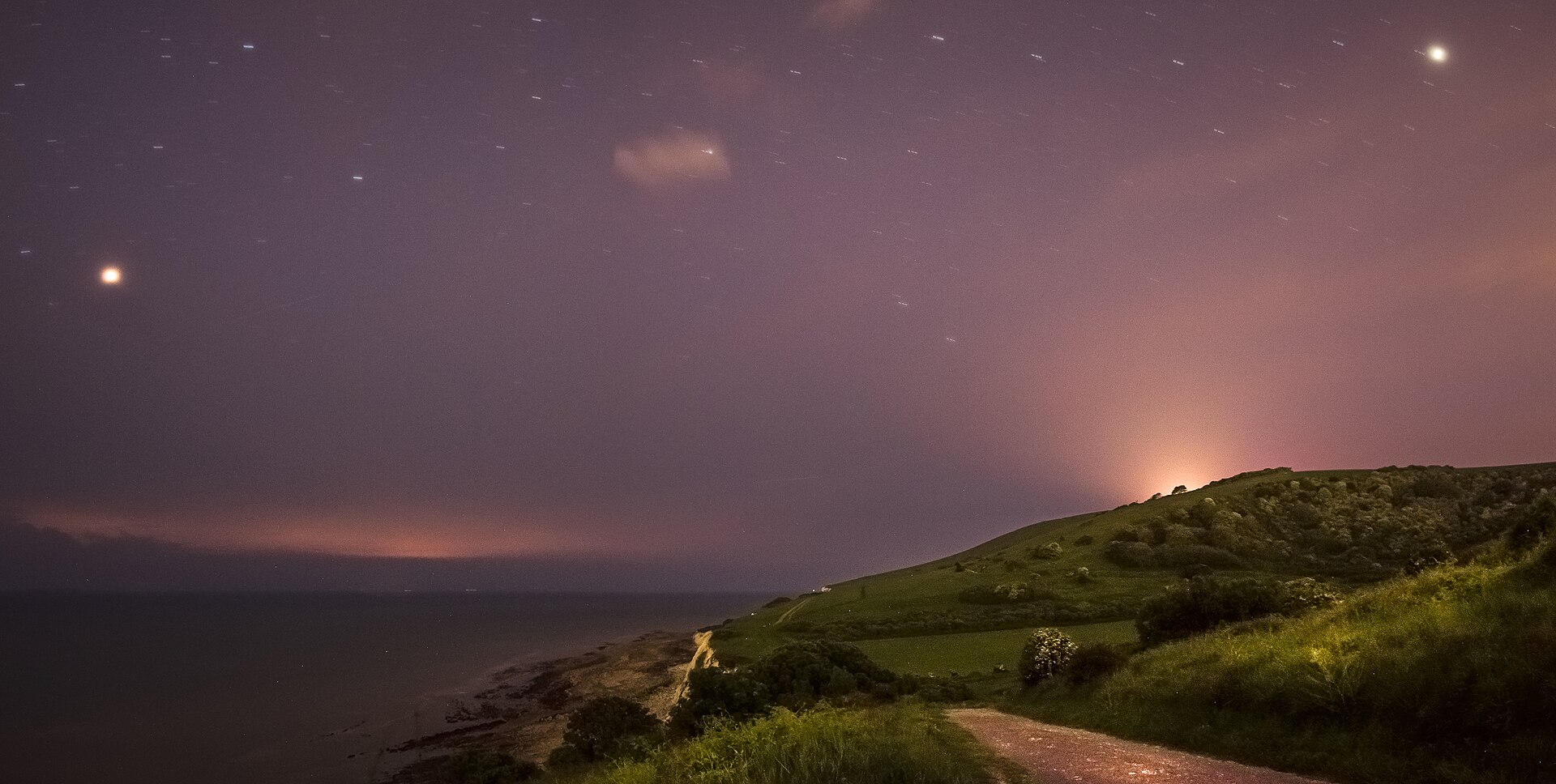
Spain’s Law 31/1988, the Law of the Sky, protects the astronomical quality of the observatories of the Instituto de Astrofísica de Canarias. Its lighting rules cover the whole of La Palma and part of Tenerife, and in January 1992 the institute set up a technical office to help apply them. The result is that on La Palma the streetlights are designed with the astronomers in mind, and the stars are better for it.
Roque de los Muchachos: the summit of La Palma
The Roque de los Muchachos Observatory sits 2,396 metres up in the municipality of Garafía, across 189 hectares of summit ridge. The IAC says it holds the largest optical and infrared telescope in the world, among a crowd of other domes. On many evenings the cloud settles below the summit, and the observatory floats on it like a fleet at anchor.
Teide Observatory: where the Sun was first heard
On Tenerife, the Teide Observatory occupies 50 hectares at Izaña, 2,390 metres up. Its first telescope began work in 1964, and in 1979 it became, in the IAC’s words, the birthplace of helioseismology: the study of the Sun’s interior through the vibrations of its surface, astronomy’s nearest thing to a stethoscope. The volcano that towers over it has a chapter of its own in our volcano story.
Garajonay: a forest from another age
Below the clouds, on La Gomera, lies something older than any telescope. Garajonay National Park, declared by law in 1981 and listed by UNESCO as a World Heritage Site in 1986, covers 3,984 hectares, and Spain’s national parks service describes its laurel forest as a relict ecosystem of the Tertiary, kept alive by a persistent envelope of mist. It holds more than half of the mature laurel forest left in the archipelago.
Walk in on a damp morning and the effect is theatrical: twisted trunks furred with moss, ferns underfoot, and the cloud drifting through the canopy rather than above it. The trees comb water from the passing mist: a forest that, in part, lives on air.

Photo Credit
Image courtesy of © H. Zell · CC BY-SA 3.0La Palma: an island in the biosphere
La Palma has been a UNESCO biosphere reserve since 1983, when 511 hectares around the laurel forest of Los Tiles made it the first Spanish island to hold the title. On 6 November 2002 UNESCO extended it to the whole island. At its heart, the Caldera de Taburiente, declared a national park on 6 October 1954 and covering 4,690 hectares, is a great cirque 8 kilometres across, walled by cliffs and laced with streams.
The island is also young and restless. The eruption on Cumbre Vieja that began on 19 September 2021 ended on 13 December, and on 25 December Spain’s National Geographic Institute declared it over.

Photo Credit
Image courtesy of © Llez · CC BY-SA 3.0Our advice: go up for sunset and stay for the dark, with warm layers, since nights at 2,400 metres are cold even in summer. Use a red torch or none at all, and never shine headlights at the domes. In Garajonay and Los Tiles, keep to marked paths and treat the mist as part of the visit: the forest looks best when it is dripping.
Since 1988, the night sky over La Palma has had its own law.
Sources
- Instituto de Astrofísica de Canarias: protection of the sky
- Instituto de Astrofísica de Canarias: Roque de los Muchachos Observatory
- Instituto de Astrofísica de Canarias: Teide Observatory
- Spain’s national parks (OAPN): Garajonay, technical sheet
- Spain’s national parks (OAPN): Caldera de Taburiente, technical sheet
- La Palma Biosphere Reserve
- Instituto Geográfico Nacional: volcanic activity news, 2021